

Tree Campus USA
Tree Campus USA
The Tree Campus USA program is run by the Arbor Day Foundation. As a forestry program, it is tailored to help college campuses care for their trees. By embracing trees on campus, we are promoting a healthier forest that both mitigates our climate impact and supports community well-being. As tree advocates, we ensure that the St. Lawrence University community commits to conservation of the campus forest by meeting the annual program standards
Resources
Who to contact for more information, to advertise an event, or to become a member?
- Matthew Ferland, student President- mferl21@stlawu.edu
- Violet Bisset, student Vice President- vbiss23@stlawu.edu
- Jon Rosales, Faculty Advisor- jrosales@stlawu.edu
The St. Lawrence University Tree Care Plan serves to:
• Actively engage both the campus and local community on tree and forest education and
ecological restoration,
• Preserve and protect existing trees, especially individual trees, stands, and forests of
healthy, native or non-invasive species, and
• Account for existing trees early in the planning and design processes when
development occurs to maximize preservation and incorporate the natural landscape
into the design.
Leadership Team
- Matthew Ferland – Student President (Term 2024/2025)
- Sara Ashpole - Associate Professor. Environmental Studies. Faculty Advisor (Term 2022/2024)
- Marcus Sherburne – Assistant Director Grounds & Campus Support Facilities Operations (Term indefinite)
Faculty & Staff Members:
- Erika Barthelmess – Professor, Biology Department and Director of Nature Up North
- Carol Cady – GIS/Map Librarian
- Paul Doty – Curator of Special Collections and University Archives Librarian
- Robert Foster – Digital Resources Curator, Art and History Department
- Daniel French – Project Manager, Nature Up North
- Cole Fuller – AmeriCorps Member, Climate Action Leader
- Caitlin Hatz – Director of Off-Campus Programs, Center for International and Intercultural Studies
- Diane Husic – Executive Director, Center for the Environment
- Michael Iverson – Assistant Director of Sustainability and Energy Management, Facilities Operations
- Mert Kartal – Associate Professor, Political Science (Government)
- Erika Kissam – Adjunct Assistant Professor, Performance and Communications Arts Department
- Tsewang Lama – Director of International Student Services, International Student Services
- Ceyda Onaran Kartal – Administrative Assistant, ENVS, GS, GNDR, CNS
- Jon Rosales – Professor, Environmental Studies Department
- Marsha Sawyer – Director of C-STEP and McNair Scholars Program
- Cathy Shrady – Associate Professor, Geology
- Mark Sturges – Associate Professor, English Department
- Eileen Visser – General Biology Course Coordinator and Outdoor Studies Staff
- Natasha Vokhshoori – Adjunct Assistant Professor, Geology
- Eric Williams-Bergen – Director of Digital Initiatives, Library
Student Members:
-
Charles Beams ('25)
-
Shifan Shaffe ('25)
-
Violet Schwartz ('25)
-
Elizabeth Anderson ('26)
-
Jenna Stinson ('27)
-
Ella D'Andreano ('27)
-
Elise Heppell ('27)
-
Lucia Hillman ('28)
-
Josie Dittman ('28)
-
Emerson Widowski ('28)
Upcoming Events Spring 2025:
- The first club meeting of the Tree Campus Club- date TBD
- Tree Tapping workshop- March
- Arbor Day- April 25
- Tree Planting Event- end of April
- Tree ID with Nature up North- date TBD
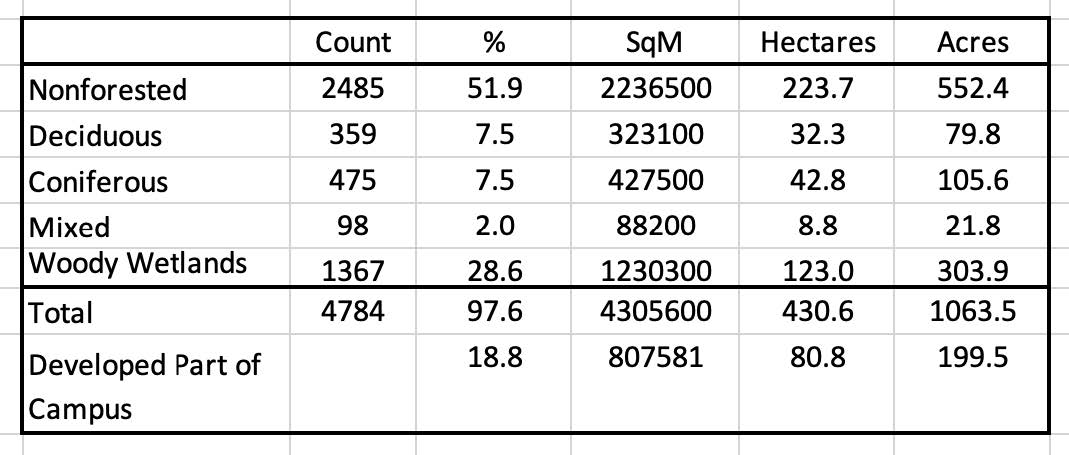
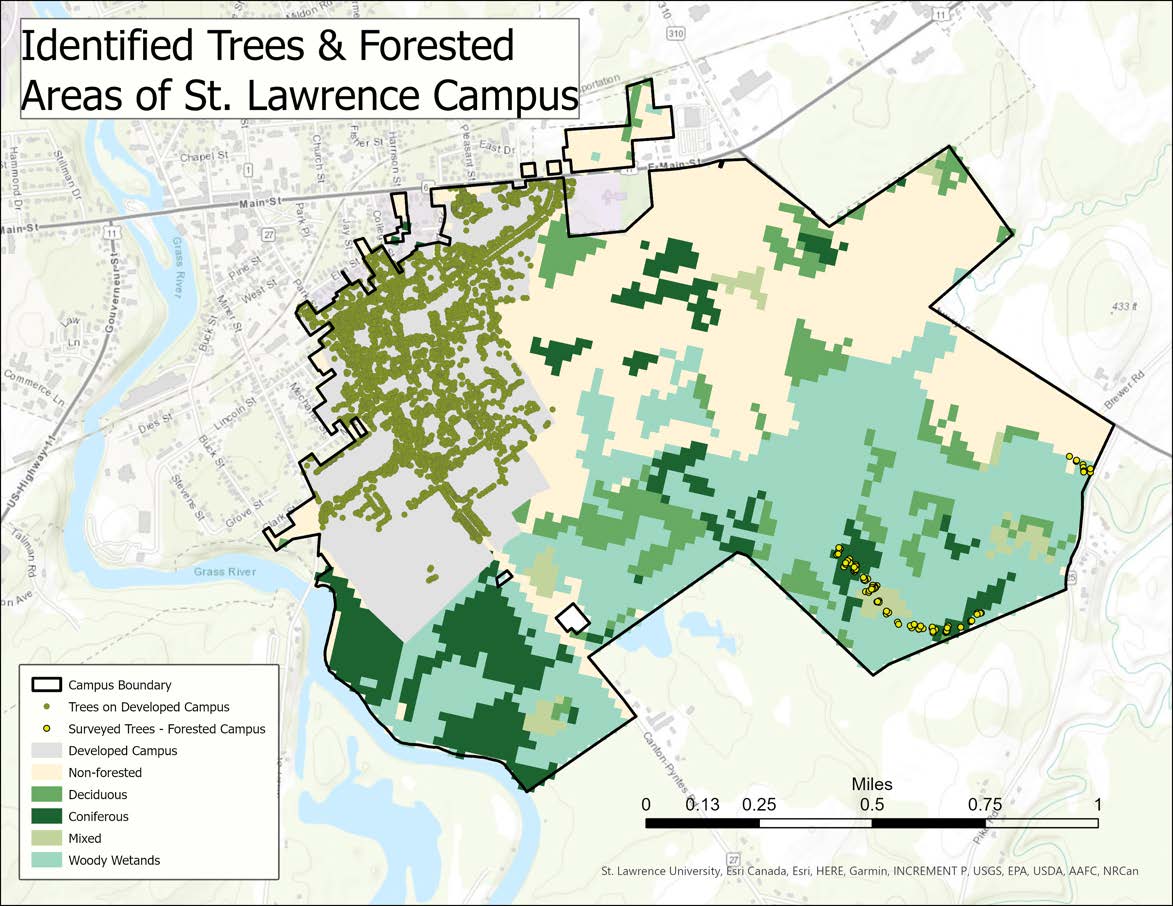
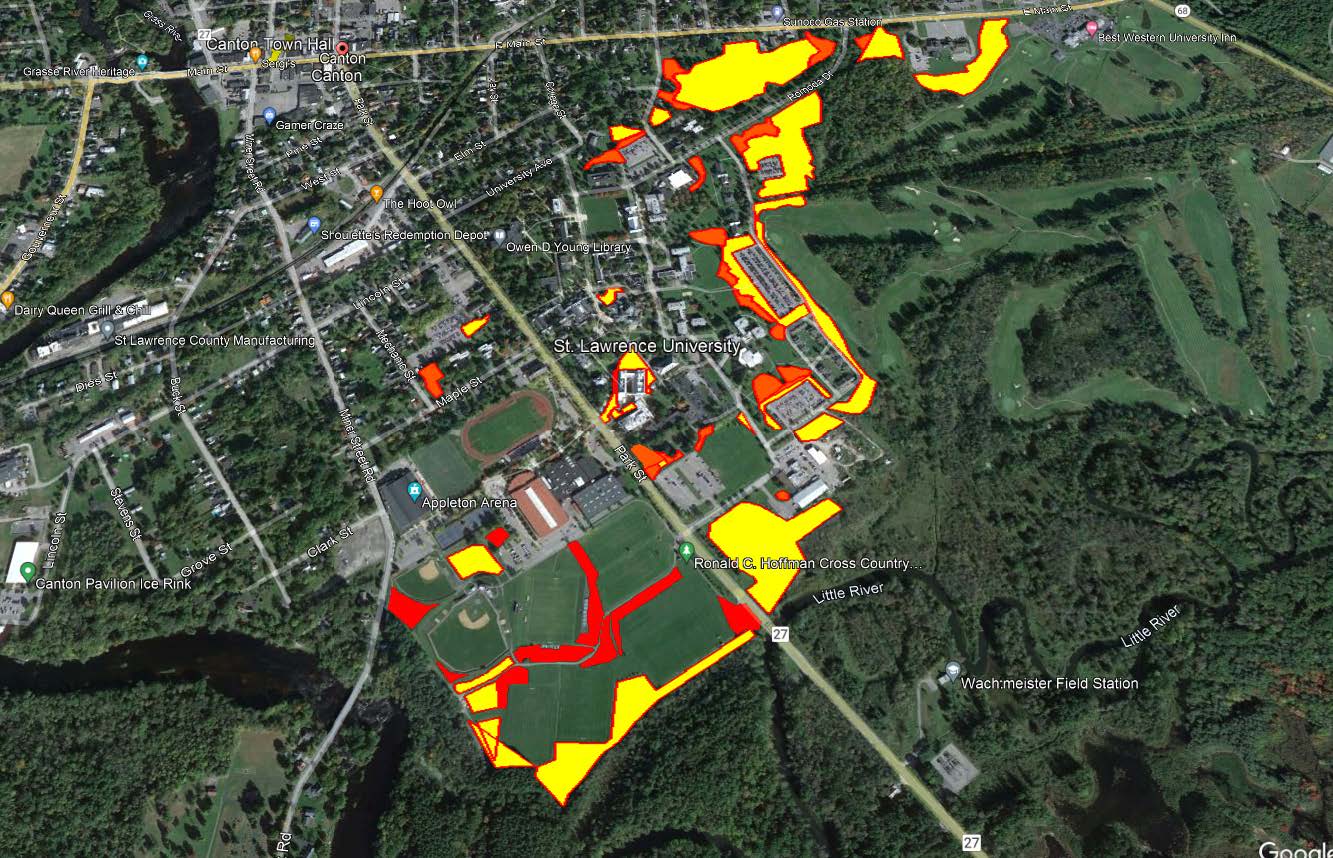
Identified Tree and Forested Areas of the St. Lawrence Campus
Number of Trees Planted
In 2024, we planted 89 total trees on the built campus (around academic buildings) of St. Lawrence University and 38 at the Living Lab a 130 acre property managed by the Environmental Studies Department. The tree species planted were carefully selected to be climate resilient to the area, expected to do well under climate projections for 2100. These species were selected through student-faculty research and based on models developed by the US Forest Service.
Number of Trees Pruned - ~689
Number of Trees Removed - 90
Reason for removal of trees
● Storm damage
● Disease damage
● EAB plan – Note infestation moving twice as fast as expected
● Invasive Buckthorn, Honeusuckle
Landscaping, Maintenance, Removal, Planting Catastrophic Events:
St. Lawrence University Facilities and Operations oversee all regular maintenance, landscaping,
and catastrophic event response, including subcontract work (see Appendix 3 for costs). Routine
maintenance schedules include surveying for damage/disease, pruning (see ANSI A300: Tree,
Shrub, and Other Woody Plant Maintenance- Standard Practices), risk to buildings/humans,
watering, fertilizing, leaf management (composting when required), and restoration/planting
replacement opportunities. The campus is pesticide free, with the exception of some of the
athletic fields. Tree planting follows the ANSI A300: Tree, Shrub, and Other Woody Plant
Maintenance- Standard Practices (Planting and Transplanting), and includes watering, mulching,
protection, bracing, monitoring. Removal of trees is typically due to catastrophic events,
disease/pest, ecological community risk, human hazard, or building construction. Under each
scenario the risk level, cost, and logistic timing are considered. Tree species will be selected
using a variety of criteria (Appendix 4) to boost campus biodiversity, including climate
adaptability, resilience, and non-invasive species. Trees are using the ANSI A300: Tree, Shrub,
and Other Woody Plant Maintenance- Standard Practices (Planting and Transplanting).
The most common catastrophic event is severe tree damage due to extreme ice and wind,
effected trees have a rapid risk assessment to ensure risk to people and/or structures is addressed.
Facilities and operations coordinate and develop a plan to restore or remove damage trees, and
time permitting consult with the Tree Advisory committee.
List of recommended species for recommended climate-adapted species.
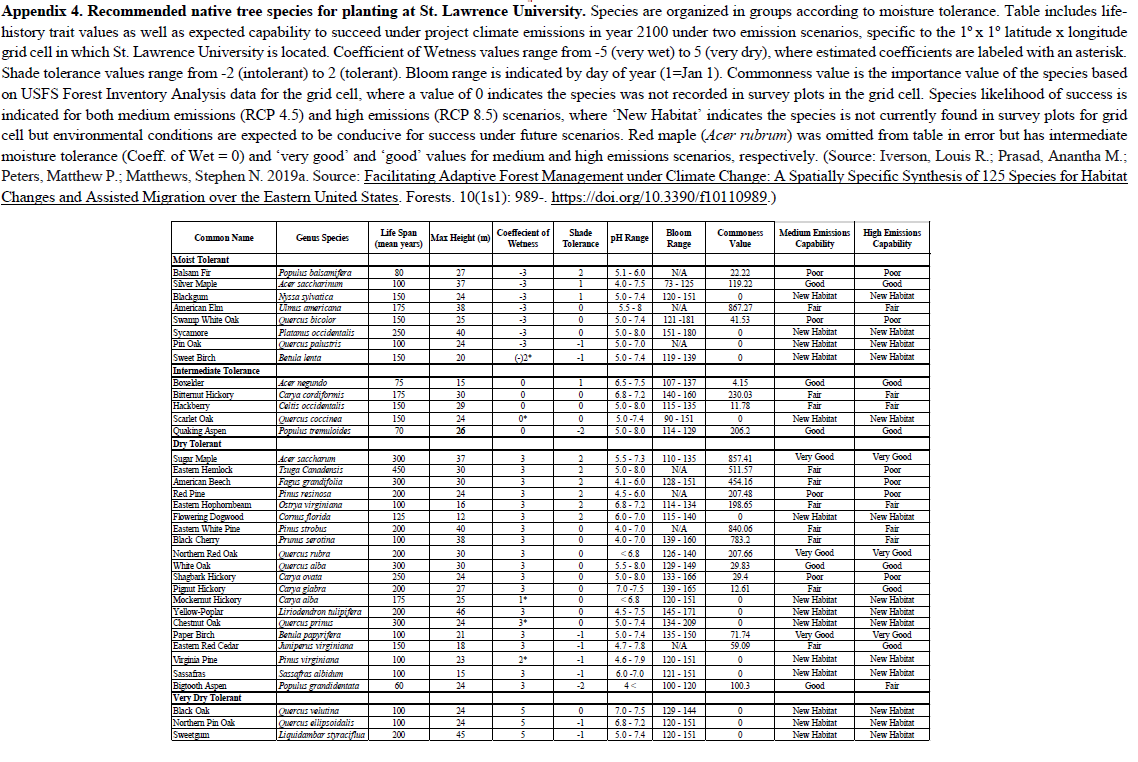
Prohibited species include any species currently on the New York State invasive species list.
Tree species prohibited from planting at St. Lawrence University:
Any plants (trees and non-trees) on the New York State Prohibited and Regulated Invasive
Plants list: (https://extapps.dec.ny.gov/docs/lands_forests_pdf/isprohibitedplants2.pdf).
This list includes the following tree:
- Acer pseudoplatanus (sycamore maple)
In addition, we prohibit the planting of the following tree species known to show potential of
invasiveness (as identified by New York State Department of Transportation;
https://www.dot.ny.gov/divisions/engineering/environmental-analysis/landscape/trees/isvegetation)
- Acer platanoides (Norway maple)
- Ailanthus altissima (tree-of-heaven)
- Robinia pseudoacacia (black locust)
Protection and Preservation Policies and Procedures
The following steps follow the federal guideline to the best of our ability, noting that the
developed portion of the campus footprint is generally at a cap for trees due to maintaining open
areas and buidling integrity:
- Preconstruction conferences with regards to existing landscaping
- Fence off tree(s)
- Designated driving areas to remove compaction; fencing off to prevent damage to roots
- Most trees within construction site removed – too big to transplant
- Preserve and protect existing trees, especially individual trees, stands, and forests of healthy, native or non-invasive species. Account for existing trees early in the planning and design processes when development occurs to maximize preservation and incorporate the natural landscape into the design. In addition:
1. Trees 31.85-inches in diameter (100 inches in circumference) or greater may not be removed, unless:
1. Removal is critical to accomplishing the mission of the agency and planning/design alternatives that would preserve such tree(s) have been explored and determined incapable of accommodating program
requirements, or
2. The tree(s) are considered invasive, hazardous, or high risk per an Arborist’s evaluation.
2. All possible considerations should be taken to preserve and protect trees in areas
determined to be critical to the health of waters, wetlands, and tributary streams.
• Transplant or replace existing tree(s) when they are impacted by development and
preservation is not feasible, according to the following procedures:
1. Transplant healthy, native, or non-invasive tree(s) where practicable. Consult an Arborist and consider the following factors when determining if transplanting is appropriate:
a. Tree species, size, and condition
b. Historic or cultural significance of the tree (e.g., “legacy tree or legacy vegetation” or those that contribute to historic city plans and cultural landscapes)
c. Current location of the tree(s) compared with the proposed location of the tree(s) (e.g., urban condition vs. open field; shade vs. sun)
d. Soil quality at the current and proposed locations (e.g., sandy loam vs. silty clay; availability of organic matter)
e. Percent of critical root area that can be retained
f. Maintenance of tree(s) after transplanting
2. Replace tree(s) when they require removal. Replacement tree(s) should increase biodiversity, be native species or non-invasive species 1, and have a mature canopy spread equivalent to, or greater than, the tree(s) removed. Replacement tree(s) should be planted at a minimum caliper size of 2.5 inches for shade trees,
1.5 inches for ornamental trees, and six-foot height for multi- stem and evergreen trees.
a. Unless such specifications are inconsistent with the intent of culturally or historically significant landscapes.
3. Continued Replace trees according to the following procedures:
a. Tree(s) less than 10-inches in diameter: Replace one tree for every one tree removed (1:1) Tree(s) 10-inches in diameter or greater: Tree Diameter (in inches) x Species Rating (as percentage) x Condition Rating (as
percentage) = Score. For example: The replacement formula and score for a 25-inch diameter tree, with a Species Rating of 60% and Condition Rating of 75% is: 25 x .60 x .75 = 11.25. The resulting score of 11.25 equates to three trees planted to replace the 25-inch tree.
b. Tree(s) are replaced at the following rates, based on the Score:
- 1 - 4.9 = one tree
- 5 - 9.9 = two trees
- 10 - 14.9 = three trees
- 15 - 19.9 = four trees
- 20 - 24.5 = five trees
- 25 + = six trees
c. Forests and Stands of Trees: Plant 1 acre minimum for every 1 acre removed.
4. Locate replacement or transplanted tree(s), in order of preference, on:
a. The project site (e.g., within or adjacent to the limits of disturbance)
b. The property where the project site is located
c. Another site within the agency’s jurisdiction (authority) only if the preferred locations cannot accommodate the replacement trees without overcrowding, or
d. A combination of the above locations.
5. Ensure the amount of planting soil volume is consistent with current industry best practices. Consult (e.g., shade tree, ornamental, evergreen, etc.) and location (e.g., above structure, on-grade, etc.).
6. Protect tree(s) to be preserved in accordance with the most current edition of ANSI-A300,2 Part 5. Transplant, install, and maintain trees also in accordance with the most current edition of ANSI-A300, and specify replacement trees in accordance with the most current edition of ANSI-Z60.1.3 FE.G.3 Conserve
tree canopy coverage and enhance the environmental quality of the National Capital. Region by preserving existing trees, replacing trees where they have died, and transplanting or replacing trees where they require removal due to development. Tree preservation, transplant, and replacement should adhere to
the provided herein to prevent a net loss of tree canopy.
New Projects:
● Annual Environmental Studies public Arbour Day event to plant 50-75 climate-resilient
trees at the Living Lab to honor graduating class.
● Develop Thelmo Tree Campus Club application and governing documents
● Develop tree nursery proposal at Living Lab
● Develop Tree Campus website: https://www.stlawu.edu/offices/environmentalstudies/
tree-campus-usa
Ongoing Projects:
• Update campus tree inventory, including the Golf Course with has not been previously
assessed. Facilitated by GIS lab and a student intern or summer research project: STAGE
1 COMPLETE OF A 5 YEAR PLAN TO ASSESS ALL CAMPUS TREES (SEE
PROJECT DOCUMENT)
• Student led petition to the President to reinstate campus Tree Day. GOAL MOVED TO
2024, ASSIGNED TO TREE REP & THELMO FOR JAN REVIEW
• Develop Tree damage assessment—enforcement, penalties, and appeals guidelines.
GOAL MOVED TO 2024, ASSIGNED TO TREE CAMPUS INTERN
• Alumni Donor trees incentive program. CONVERSATIONS WITH SLU DONAR
RELATIONS FOR A NEW VISION (RESTORE A FOREST)
- Tree nursery on campus or at the Living Lab
- GIS campus tree inventory project with SLU student Charlie Beams
- History of Tree Holiday research project
- Invasive Species Removal Project